Foto 1 di 13



Galleria
Foto 1 di 13



Ne hai uno da vendere?
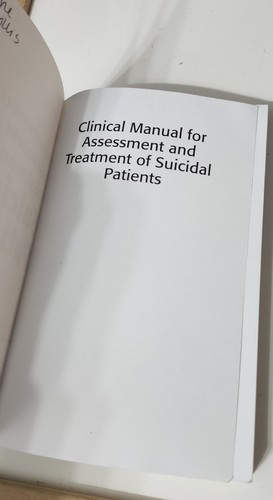
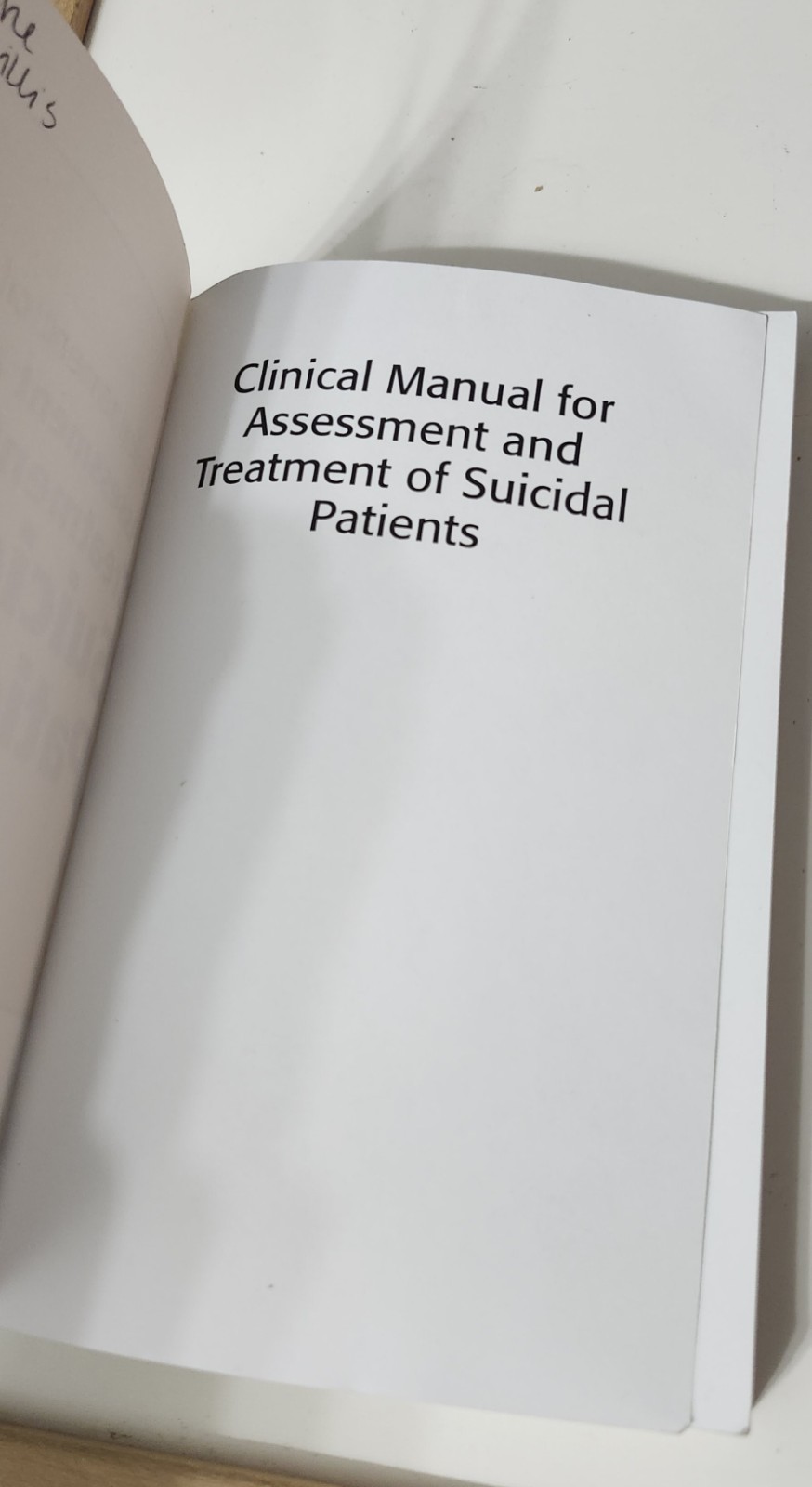
Rare Clinical Manual For Assessment And Treatment Of Suicidal Patients Book

Non Stop Thrift Shop
(434)
Venditore privato
US $219,99
CircaEUR 188,96
o Proposta d'acquisto
Condizione:
- Compralo SubitoRare Clinical Manual For Assessment And Treatment Of Suicidal Patients Book
Oops! Looks like we're having trouble connecting to our server.
Refresh your browser window to try again.
Spedizione:
US $9,99 (circa EUR 8,58) USPS Media MailTM.
Oggetto che si trova a: La Center, Washington, Stati Uniti
Consegna:
Consegna prevista tra il gio 11 dic e il mer 17 dic a 94104
Restituzioni:
Restituzioni non accettate.
Pagamenti:
Fai shopping in tutta sicurezza
Informazioni sull'oggetto
Il venditore si assume la piena responsabilità della messa in vendita dell'oggetto.
Numero oggetto eBay:366033252582
Specifiche dell'oggetto
- Condizione
- Release Year
- 2004
- Book Title
- Clinical Manual For Assessment And Treatment Of Suicidal Patie...
- ISBN
- 9781585621408
Informazioni su questo prodotto
Product Identifiers
Publisher
American Psychiatric Association Publishing
ISBN-10
1585621404
ISBN-13
9781585621408
eBay Product ID (ePID)
102775411
Product Key Features
Number of Pages
360 Pages
Language
English
Publication Name
Clinical Manual for Assessment and Treatment of Suicidal Patients
Publication Year
2004
Subject
Psychiatry / General, Suicide
Type
Textbook
Subject Area
Psychology, Medical
Format
Trade Paperback
Dimensions
Item Height
0.8 in
Item Weight
14.4 Oz
Item Length
8.2 in
Item Width
5.5 in
Additional Product Features
Intended Audience
Scholarly & Professional
LCCN
2004-050261
Dewey Edition
23
Reviews
"This book offers a huge resource for clinicians. The authors have drawn on their long and extensive experience to write a book that is comprehensive, practical, and wise. It invites therapists to recognize our own attitudes and values concerning suicide, and to remain aware of how these can be affected by our fears for our patients. For therapists seeking to enhance their assessment and treatment skills, this book offers a vital road map for providing effective patient care, not only before and after a suicidal crisis but also during the crisis itself. Chiles and Strosahl will prove to be valuable allies for both the experienced clinician and the student facing the complex issues that arise daily in the treatment of these troubled and anguished patients."- J. Mark G. Williams, DSc, Professor, Wellcome Principal Research Fellow, Department of Psychiatry, University of Oxford, Oxford, England, "This is an amazingly clear and comprehensive clinical guide on suicidality, filled with the 'uncommon-sense' that can only come from a deep understanding of the most current scientific literature. Fortunately, Chiles and Strosahl have done all the hard work for the reader: what is presented in this excellent book is practical, simple, accessible, and wise counsel on one of the most difficult issues clinicians must face."- Steven C. Hayes, Ph.D., Foundation Professor, Department of Psychology, University of Nevada, Reno, Nevada, "This comprehensive text covers everything from the basic causes and diagnosis of suicidality, to treatment strategies and suggestions for comprehensive set-up of community and hospital based services for the suicidal patient and their family.... It is highly recommended as an excellent, readable resource for clinicians and administrators in the mental health and medical fields. It deserves a place on the bookshelves of any educational or professional library serving students or practitioners in the fields of medicine, psychiatry, social work, psychology, or counseling."- E-Streams, "A psychiatrist and psychologist have teamed up to outline a workable approach for addressing suicidal patients. The book encourages professionals of all disciplines to examine their own attitudes about suicide and their impact on their work. The authors seek to offer accessible and wise advice on one of the most difficult challenges clinicians will experience."- Behavioral Healthcare Tomorrow, This comprehensive text covers everything from the basic causes and diagnosis of suicidality, to treatment strategies and suggestions for comprehensive set-up of community and hospital based services for the suicidal patient and their family.... It is highly recommended as an excellent, readable resource for clinicians and administrators in the mental health and medical fields. It deserves a place on the bookshelves of any educational or professional library serving students or practitioners in the fields of medicine, psychiatry, social work, psychology, or counseling.
Grade From
College Graduate Student
Illustrated
Yes
Dewey Decimal
616.85/8445
Table Of Content
ContributorPrefaceChapter 1. Introduction: The dimensions of suicidal behaviorChapter 2. The clinician's emotions, values, legal exposure, and ethics: global issues in the treatment of suicidal patientsChapter 3. A basic model of suicidal behaviorChapter 4. Assessment of suicidal behavior and predisposing factors: blending your assessment with treatmentChapter 5. Outpatient interventions with suicidal patientsChapter 6. The repetitiously suicidal patient: evaluation, psychotherapy, and basic case managementChapter 7. Managing suicidal emergencies: more on crisis and case managementChapter 8. Hospitals and suicidal behavior: a complex relationshipChapter 9. Working with special populations: substance-abusing, psychotic, young, and elderly patientsChapter 10. Suicidal patients in general health careChapter 11. Understanding and providing care to survivors of suicideAppendix A: Philosophies about suicideAppendix B: Consequences of suicidal behavior questionnaireAppendix C: Reasons for living inventoryAppendix D: Suicidal thinking and behaviors questionnaireAppendix E: Malpractice management assessmentIndex
Synopsis
The cornerstone of any intervention approach with suicidal patients is the recognition and treatment of psychiatric disorders. For many patients, however, treating the mental illness is not enough -- that is, suicidal behavior is not necessarily reduced by treatments that target those illnesses. Something more is needed. In this provocative and insightful work, Drs. Chiles and Strosahl offer a concrete, practical framework to fill this gap. In doing so, they challenge one of the chief underlying assumptions of traditional approaches to suicide assessment and treatment -- that suicidal behavior can be predicted and controlled. In its place, they propose a new conceptualization of suicidality -- as learned, reinforced problem-solving behaviors that an individual uses when all other options seem to have failed. Rather than focusing on risk prediction and management, interventions in this learning model target the problems that the suicidal behavior is being used to solve. The assumption is that a patient's suicidal behavior represents his or her best attempt at that moment in time to deal with life's difficulties. The clinician's initial task is therefore not to judge or criticize but rather to acknowledge the struggle and pain the patient is experiencing and to help the patient begin to explore other ways of dealing with the overwhelming troubles. Efforts to reduce suicidal risk are accomplished by techniques that maximize individual autonomy and encourage positive behaviors -- the person's unique resources for addressing and modifying the suicidal behavior. Designed to be used both for personal instruction and as a training manual, this comprehensive guide * Presents an evidence-based model for understanding and treating suicidal behavior in all its forms. * Features self-evaluation exercises to help clinicians develop an enhanced awareness of their own emotional reactions, moral/religious responses, and personal values about suicidality. * Provides interactive checklists and patient assessment tools designed for easy use by the typical clinician in daily practice. * Includes case vignettes and narratives highlighting key assessment and intervention principles. In Clinical Manual for the Assessment and Treatment of Suicidal Patients, the authors -- a psychiatrist and clinical psychologist -- have combined their diverse training and disciplinary backgrounds to create a workable approach to dealing with suicidal patients. Much more than merely an academic text on suicide, this thought-provoking handbook provides detailed guidance and a true sense of what to do to help suicidal patients. Practitioners in all domains of health care -- clinicians, residents, therapists, and graduate students in psychiatry, psychology, social work, and nursing -- will benefit from this valuable and accessible work., The authors combine their diverse training and disciplinary backgrounds to create a workable approach to dealing with suicidal patients. Much more than merely an academic text on suicide, this thought-provoking handbook provides detailed guidance and a true sense of what to do to help suicidal patients., The cornerstone of any intervention approach with suicidal patients is the recognition and treatment of psychiatric disorders. For many patients, however, treating the mental illness is not enough -- that is, suicidal behavior is not necessarily reduced by treatments that target those illnesses. Something more is needed. In this provocative and insightful work, Drs. Chiles and Strosahl offer a concrete, practical framework to fill this gap. In doing so, they challenge one of the chief underlying assumptions of traditional approaches to suicide assessment and treatment -- that suicidal behavior can be predicted and controlled. In its place, they propose a new conceptualization of suicidality -- as learned, reinforced problem-solving behaviors that an individual uses when all other options seem to have failed. Rather than focusing on risk prediction and management, interventions in this learning model target the problems that the suicidal behavior is being used to solve. The assumption is that a patient's suicidal behavior represents his or her best attempt at that moment in time to deal with life's difficulties. The clinician's initial task is therefore not to judge or criticize but rather to acknowledge the struggle and pain the patient is experiencing and to help the patient begin to explore other ways of dealing with the overwhelming troubles. Efforts to reduce suicidal risk are accomplished by techniques that maximize individual autonomy and encourage positive behaviors -- the person's unique resources for addressing and modifying the suicidal behavior. Designed to be used both for personal instruction and as a training manual, this comprehensive guide - Presents an evidence-based model for understanding and treating suicidal behavior in all its forms. - Features self-evaluation exercises to help clinicians develop an enhanced awareness of their own emotional reactions, moral/religious responses, and personal values about suicidality. - Provides interactive checklists and patient assessment tools designed for easy use by the typical clinician in daily practice. - Includes case vignettes and narratives highlighting key assessment and intervention principles. In Clinical Manual for the Assessment and Treatment of Suicidal Patients, the authors -- a psychiatrist and clinical psychologist -- have combined their diverse training and disciplinary backgrounds to create a workable approach to dealing with suicidal patients. Much more than merely an academic text on suicide, this thought-provoking handbook provides detailed guidance and a true sense of what to do to help suicidal patients. Practitioners in all domains of health care -- clinicians, residents, therapists, and graduate students in psychiatry, psychology, social work, and nursing -- will benefit from this valuable and accessible work.
LC Classification Number
RC569.C478 2004
Descrizione dell'oggetto fatta dal venditore
Informazioni su questo venditore

Non Stop Thrift Shop
100% di Feedback positivi•815 oggetti venduti
Registrato come venditore privatoPertanto non si applicano i diritti dei consumatori derivanti dalla normativa europea. La Garanzia cliente eBay è comunque applicabile alla maggior parte degli acquisti. Scopri di piùScopri di più
Feedback sul venditore (366)
- r***a (39)- Feedback lasciato dall'acquirente.Mese scorsoAcquisto verificatoShe’s beautiful. I had one and accidentally dropped her sunday and she broke, this is a replacement. Very Fast shipping and AMAZING packaging for my porcelain beauty. Exactly as described, pricing was fair and considering the amazing packaging definitely worth the shipping price She made it home perfectly protected..I needed to get the replacement fast and getting her brand new was very important to me. I’m very happy with my purchase. Thank you! I highly recommended shop
- 7***r (104)- Feedback lasciato dall'acquirente.Ultimi 6 mesiAcquisto verificatoThe item that I ordered was exactly as described. The packing was particularly impressive because this seller took extra precautions to make sure that no damage occured to the item during shipment. I would definitely buy from this seller again!
- c***6 (22)- Feedback lasciato dall'acquirente.Ultimi 6 mesiAcquisto verificatoItem just as described and packaged well for shipping, however shipping was very slow. Thank you. A+ seller.
Vedi altro:
- Libri e riviste di saggistica manuali,
- Libri e riviste di saggistica manuale illustrato,
- Libri e riviste di saggistica manuali adulti,
- Libri e riviste di saggistica manuali giovane,
- Libri e riviste di saggistica manuali da Italia,
- Libri e riviste di saggistica manuali viaggio,
- Libri e riviste di saggistica manuali da Francia,
- Libri e riviste di saggistica manuale in francese,
- Libri e riviste di saggistica manuali in italiano,
- Libri e riviste di saggistica manuali prima edizione
Non Stop Thrift Shop
100% di Feedback positivi•815 oggetti venduti
Registrato come venditore privatoPertanto non si applicano i diritti dei consumatori derivanti dalla normativa europea. La Garanzia cliente eBay è comunque applicabile alla maggior parte degli acquisti. Scopri di piùScopri di più
Feedback sul venditore (366)
- r***a (39)- Feedback lasciato dall'acquirente.Mese scorsoAcquisto verificatoShe’s beautiful. I had one and accidentally dropped her sunday and she broke, this is a replacement. Very Fast shipping and AMAZING packaging for my porcelain beauty. Exactly as described, pricing was fair and considering the amazing packaging definitely worth the shipping price She made it home perfectly protected..I needed to get the replacement fast and getting her brand new was very important to me. I’m very happy with my purchase. Thank you! I highly recommended shop
- 7***r (104)- Feedback lasciato dall'acquirente.Ultimi 6 mesiAcquisto verificatoThe item that I ordered was exactly as described. The packing was particularly impressive because this seller took extra precautions to make sure that no damage occured to the item during shipment. I would definitely buy from this seller again!
- c***6 (22)- Feedback lasciato dall'acquirente.Ultimi 6 mesiAcquisto verificatoItem just as described and packaged well for shipping, however shipping was very slow. Thank you. A+ seller.