Foto 1 di 1
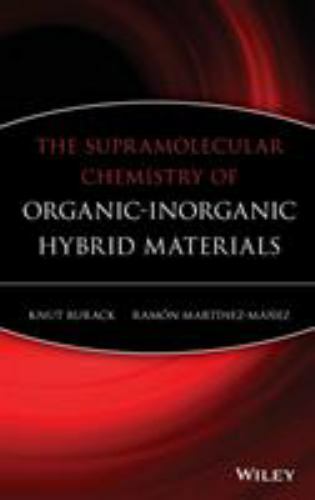
Foto di catalogo

Foto 1 di 1
Foto di catalogo
Supramolecular Chemistry of Organic-Inorganic Hybrid Materials by Ramon Martinez-Manez (2010, Hardcover)

Great Book Prices Store (364214)
98,1% di feedback positivi
Prezzo:
US $203,19
CircaEUR 174,10
+ $19,99 di spese di spedizione
Restituzioni:
Condizione:
The push for greater advances in nanotechnology has been driving a convergence of supramolecular chemistry and materials chemistry--two disciplines that have not traditionally been particularly interrelated--into the interfacial zone of nanotechnology and nanochemistry and attempts to combine inorganic materials with functional organic molecules.
- Compralo SubitoSupramolecular Chemistry of Organic-Inorganic Hybrid Materials, Hardcover by ...
Oops! Looks like we're having trouble connecting to our server.
Refresh your browser window to try again.
Informazioni su questo prodotto
Product Identifiers
PublisherWiley & Sons, Incorporated, John
ISBN-10047037621X
ISBN-139780470376218
eBay Product ID (ePID)22038279726
Product Key Features
Number of Pages816 Pages
LanguageEnglish
Publication NameSupramolecular Chemistry of Organic-Inorganic Hybrid Materials
Publication Year2010
SubjectChemistry / Physical & Theoretical, Nanotechnology & Mems, Chemistry / Analytic, Chemistry / Organic
TypeTextbook
Subject AreaTechnology & Engineering, Science
AuthorRamon Martinez-Manez
FormatHardcover
Dimensions
Item Height1.8 in
Item Weight45.4 Oz
Item Length9.6 in
Item Width6.5 in
Additional Product Features
Intended AudienceScholarly & Professional
LCCN2009-019352
TitleLeadingThe
Reviews"This book will find use for those generally interested in such hybrid systems. With some prior knowledge, one can browse through the topics and then proceed to the literature for more complete and in-depth coverage." ( JACS , 2010)
IllustratedYes
Dewey Decimal620.11
Table Of ContentPreface. Editors and Contributors. 1. Hybrid (Nano)Materials Meet Supramolecular Chemistry: A Brief Introduction To Basic Terms And Concepts ( Knut Rurack and Ramón Martínez-Máñez ). 2. Supramolecular Chemistry at the Mesoscale ( Katsuhiko Ariga, Gary J. Richards, Jonathan P. Hill, Ajayan Vinu, and Toshiyuki Mori ). Part One Organic-Inorganic Hybrid Nanomaterials. 3. Silica-Based Mesoporous Organic-Inorganic Hybrid Materials ( Frank Hoffmann and Michael Fröba ). 4. Modified Gold Nanoparticles and Surfaces ( Paolo Pengo and Lucia Pasquato ). 5. Organically Functionalized Semiconductor Nanocrystals: Synthesis, Properties and System Design for Optoelectronic Applications ( Peter Reiss, Julia De Girolamo and Adam Pron ). 6. Functionalized Carbon Nanotubes for Bioapplications ( Lingrong Gu, Fushen Lu, Pengju G. Luo, Haifang Wang, Mohammed J. Meziani, and Ya-Ping Sun ). 7. Metal-Organic Frameworks (MOFs) and Coordination Polymers ( Shin-Ichiro Noro and Susumu Kitagawa) . Part Two Improvement of Signaling and Sensing by Organization on Surfaces. 8. Nanoparticle and Biomolecular-Nanoparticle Hybrid Supramolecular Complexes for Electrochemical Signaling ( Ronen Polsky, Jason C. Harper and Susan M. Brozik ). 9. Modified Nanoparticles as Nanoelectrocatalysts and Amplifying Sensors ( Shaojun Guo, Erkang Wang and Xiurong Yang ). 10. Signal Generation with Gold Nanoparticles: Photophysical Properties for Sensor and Imaging Applications ( Qingshan Wei and Alexander Wei ). 11. Optical Signaling with Silica Nanoparticles ( Fabrizio Mancin, Paolo Tecilla, and Umberto Tonellato ). 12. Organically Modified Quantum Dots in Chemical and Biochemical Analysis ( María Teresa Fernández Argüelles, José M. Costa-Fernández, Rosario Pereiro and Alfredo Sanz-Medel ). Part Three Control of Supramolecular Nanofabrication, Motion, and Morphology. 13. Chemically Directed Self-Assembly of Nanoparticle Structures on Surfaces ( Xing Yi Ling, David N. Reinhoudt and Jurriaan Huskens ). 14. Immobilization and Patterning of Biomolecules on Surfaces ( Dorota I. Rozkiewicz, Bart Jan Ravoo, and David N. Reinhoudt ). 15. Switchable Host-Guest Chemistry on Surfaces ( Jilie Kong, Chunming Jiang and Li Mu ). 16. Nanogated Mesoporous Silica Materials ( Igor I. Slowing, Brian G. Trewyn, and Victor S.-Y. Lin ). 17. Building Molecular Machines on Surfaces ( Alberto Credi, Serena Silvi, and Margherita Venturi) . 18. Control of Morphology in Mesoporous and Mesostructured Hybrid Materials ( Darren Dunphy, Bernd Smarsly, and C. Jeffrey Brinker ). Part Four Biomimetic Chemistry. 19. Biomimetically Inspired Signaling ( Knut Rurack, Ramón Martínez-Máñez, Félix Sancenón and Ana B. Descalzo ). 20. Imprinted Functionalized Silica ( Maryanne M. Collinson ). 21. Bioinspired Block Copolymer-Based Hybrid Materials ( Marleen Kamperman and Ulrich Wiesner ). Part Five Interfacial Chemistry, Multifunctionality, and Interdisciplinarity. 22. Emerging Concepts in Interfacial Chemistry of Hybrid Materials: Nanocontainer-Based Self-Healing Coatings ( Dmitry G. Shchukin, Daria V. Andreeva, Katja Skorb, and Helmuth Möhwald ). 23. Molecular Schizophrenics: Switchable Materials with Multiple Functions ( Robert Byrne and Dermot Diamond ). 24. Hybrid Nanomaterials Research: Is It Really Interdisciplinary? ( Ismael Rafols, Martin Meyer, and Jae-Hwan Park ). 25. Supramolecular Chemistry Meets Hybrid ( Nano) Materials : A Brief Look Ahead (Knut Rurack and Ramón Martínez-Máñez ). Appendix 1. Index.
SynopsisThe combination of supramolecular chemistry, inorganic solids, and nanotechnology has already led to significant advances in many areas such as sensing, controlled motion, and delivery. By making possible an unprecedented tunability of the properties of nanomaterials, these techniques open up whole new areas of application for future supramolecular concepts. The Supramolecular Chemistry of Organic-Inorganic Hybrid Materials gathers current knowledge on the subject and provides an overview of the present state and upcoming challenges in this rapidly growing, highly cross- or interdisciplinary research field. The book details how these designed materials can improve existing materials or generate novel functional features such as chemical amplification, cooperative binding and signal enhancement that are difficult or not at all achievable by classical organic supramolecular chemistry. It also discusses issues related to nanofabrication or nanotechnology such as the directed and controlled assembly or disassembly, biomimetic functions and strategies, and the gating and switching of surface functions or morphology., The combination of supramolecular chemistry, inorganic solids, and nanotechnology has already led to significant advances in many areas such as sensing, controlled motion, and delivery., AN INTRODUCTION TO CONCEPTS AND APPLICATIONS OF SUPRAMOLECULAR HYBRID MATERIALS The combination of supramolecular chemistry, inorganic solids, and nanotechnology has already led to significant advances in many areas such as sensing, controlled motion, and delivery. By making possible an unprecedented tunability of the properties of nanomaterials, these techniques open up whole new areas of application for future supramolecular concepts. The Supramolecular Chemistry of Organic Inorganic Hybrid Materials gathers current knowledge on the subject and provides an overview of the present state and upcoming challenges in this rapidly growing, highly cross- or interdisciplinary research field. Chapters cover: Basic materials design along with synthesis, characterization, and fundamental properties Supramolecular chemistry strategies and processes Signaling mechanisms and signal generation Applications in many diverse areas Future possibilities and potential trends in supramolecular hybrid materials The book details how these designed materials can improve existing materials or generate novel functional features such as chemical amplification, cooperative binding and signal enhancement that are difficult or not at all achievable by classical organic supramolecular chemistry. It also discusses issues related to nanofabrication or nanotechnology such as the directed and controlled assembly or disassembly, biomimetic functions and strategies, and the gating and switching of surface functions or morphology. Collecting exciting recent work on the fusion of two topical fields of research supramolecular chemistry and hybrid materials design this pioneering study provides an important reference for supramolecular chemists, materials scientists, analytical chemists, and high-level students in these fields.
LC Classification NumberQD882.S87 2010
Tutte le inserzioni per questo prodotto


Scrivi una recensione per primo


